

Image Details
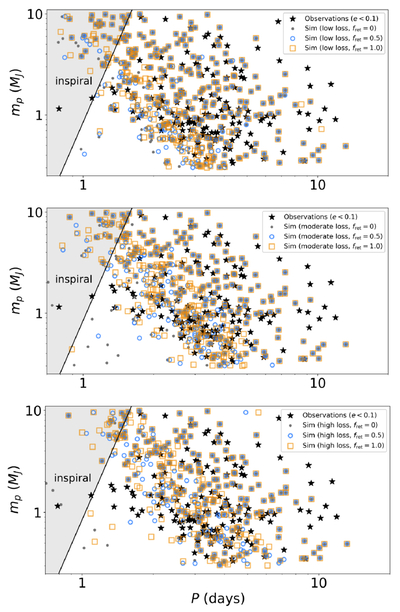
Caption: Figure 7.
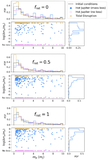
Mass–period distribution for observed hot Jupiters (black stars) that are relatively circularized (measured eccentricities e < 0.1), along with the final state of surviving hot Jupiters in the simulations (gray dots denote fret = 0, blue open circles fret = 0.5, and orange open squares fret = 1). The observed sample of hot Jupiters is taken from the NASA Exoplanet Archive (accessed 2025 August 22; e.g., R. L. Akeson et al. 2013; NASA Exoplanet Archive 2025). We select systems with 0.3MJ < mp < 10MJ and ap < 0.1 au. The top row corresponds to the low-loss case, the middle row corresponds to the moderate-loss case, and the bottom row corresponds to the high-loss case. The shaded region shows where inspiral and merger with the host star from stellar tidal dissipation is efficient, calculated using the calibration from B. M. S. Hansen (2010).
Other Images in This Article
Copyright and Terms & Conditions
© 2026. The Author(s). Published by the American Astronomical Society.

