

Image Details
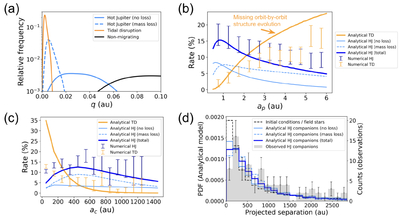
Caption: Figure 1.
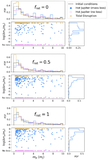
Panel (a): analytical distribution of periastra q from the fiducial population of stellar perturbers, with color-coded outcomes determined by comparing to the critical q for hot Jupiter formation (solid blue line), mass loss (dashed blue line), and tidal disruption (solid orange line). Planets that do not undergo migration or disruption are shown with a solid black line. The Monte Carlo results are smoothed using a Gaussian kernel. Panel (b): analytical estimates for the rates of tidal disruption (solid orange line), hot Jupiter production with no mass loss (solid light blue line), hot Jupiter production with mass loss (dashed light blue line), and total hot Jupiter production (solid dark blue line). Data points show simulated results from the M0 numerical run for comparison, where dark blue corresponds to hot Jupiters and orange to tidal disruptions. For each fixed planetary semimajor axis value ap, a population of 106 perturbers from 50 < a2 < 1500 au is generated following A. Duquennoy & M. Mayor (1991). Panel (c): rates are color-coded as in panel (b). For each stellar semimajor axis value a2, a population of 106 planets is drawn uniformly from 0.5 < ap < 6 au. Panel (d): distributions of projected separations for field stars from A. Duquennoy & M. Mayor (1991; dashed gray line), companions to hot Jupiters from the analytical model that do not undergo mass loss (solid light blue line), companions to hot Jupiters from the analytical model that undergo mass loss (dashed light blue line), companions to the overall analytical hot Jupiter population (solid dark blue line), and observed hot Jupiter companions (shaded gray histogram). The model distributions are displayed as a probability density function and the observations in counts.
Other Images in This Article
Copyright and Terms & Conditions
© 2026. The Author(s). Published by the American Astronomical Society.

