

Image Details
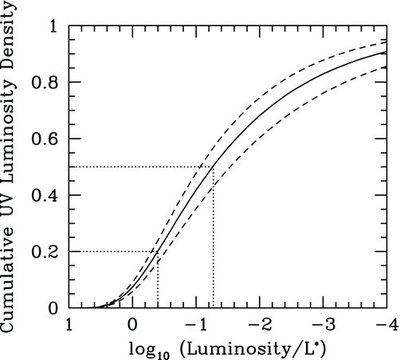
Caption: Figure 9.
Fraction of the total UV luminosity density that arises from galaxies brighter than a given luminosity (solid line). This calculation assumes the faint-end slope α of −1.73 preferred in recent determinations of the LF at z ~ 2–6 (e.g., Yoshida et al. 2006; Bouwens et al. 2007; Oesch et al. 2007; Reddy & Steidel 2009). The dashed lines show the fraction of the luminosity density brighter than specific luminosities for faint-end slopes α of −1.68 and −1.78 (which differ at the 1σ level from the α = −1.73 value preferred at z ~ 4; Bouwens et al. 2007). Note that >50% and >80% of the luminosity density occurs in galaxies fainter than 10 −1.3 L* ~ 0.05 L* and 10 −0.4 L* ~ 0.4 L*, respectively, demonstrating how important it is to understand the dust correction down to very low luminosities.
Other Images in This Article
Show More
Copyright and Terms & Conditions
© 2009. The American Astronomical Society. All rights reserved.

