

Image Details
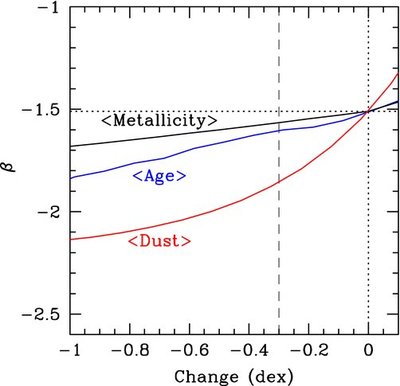
Caption: Figure 7.
UV-continuum slope β (1600–2300 Å rest-frame baseline) predicted for specific fractional changes in the mean age, metallicity, or dust extinction of high-redshift star-forming galaxies from our fiducial stellar population model. For our fiducial model (where β = −1.47), we assume t = 70 Myr, τ = 10 Myr, [ Z/ Z ☉] = −0.7, E( B − V) = 0.15, and a Salpeter IMF (where the star formation history is parameterized as e − t/τ ) from the Papovich et al. (2001) fits to z ~ 2.5 U-dropouts from the WFPC2 HDF North. In modifying our fiducial model to have younger ages, we make changes to both t and τ. A factor of 2 (0.3 dex) change (dashed line) in the mean dust content, age, or metallicity of the star-forming galaxy population at high-redshift shifts the UV-continuum slope β by ~0.35, ~0.1, and ~0.05, respectively. The effect of the stellar IMF on β is not shown here, but results in only modest changes in β, i.e., Δβ ≲ 0.1 for a ~0.5 shift in the slope of the IMF. It seems clear that changes in the mean dust content of galaxies at high redshift has the biggest effect on the UV-continuum slope β—though some change is also likely the result of differences in the average age. Nonetheless, since stellar population modeling of z~4–6 dropout galaxies (Stark et al. 2009) suggest that age shows little dependence on redshift or luminosity (at least in the median), it seems likely that age only plays a minor role (Δβ ≲ 0.2) in driving the observed trends (Section 4.4).
Other Images in This Article
Show More
Copyright and Terms & Conditions
© 2009. The American Astronomical Society. All rights reserved.

