

Image Details
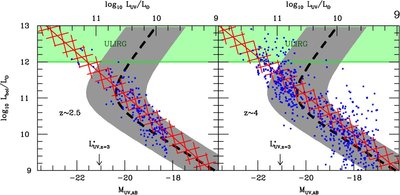
Caption: Figure 10.
Bolometric luminosity vs. observed UV luminosity M UV, AB . The top axis gives this UV luminosity in units of L ☉. The blue points give the UV luminosities and equivalent bolometric luminosities (after dust correction) for individual sources in our z ~ 2.5 U-dropout and z ~ 4 B-dropout samples (see Figure 3). The dust correction utilizes the observed UV-continuum slopes β and the Meurer et al. (1999) IRX-β relationship. Note that the red line is not a direct fit to the blue points (see Section 3.7 and Figure 3). The red line shows the expected relation between bolometric luminosity and UV luminosity using the luminosity-dependent dust correction derived in Section 5.5 (see Equation (2)). These luminosity-dependent dust corrections are derived utilizing the correlation between UV-continuum slope β and M UV, AB we found for z ~ 2.5 U-dropouts and z ~ 4 B-dropouts (see Section 3.9) and the Meurer et al. (1999) relationship. The hatched red region indicates the expected 1σ scatter in the bolometric luminosities for a given UV luminosity (based upon the observed scatter of ~0.4 in the UV-continuum slope at a fixed UV luminosity). Since it is unclear whether the Meurer et al. (1999) IRX-β relationship can be accurately used to estimate extinctions for galaxies with >10 12 L ☉ luminosities (e.g., Chapman et al. 2005; Reddy et al. 2006), caution should be used in interpreting the blue points or red lines which extend beyond 10 12 L ☉ (green shaded region). The black dashed line shows the relationship between UV luminosity and β that one would derive utilizing the correlation Reddy et al. (2006) found between bolometric luminosity and dust obscuration (see Section 5.5). The shaded gray region corresponds to a ~0.4 dex scatter in the dust obscuration. Notice how the population of bluer, more dust-free dropout galaxies in our selections span a wide range in bolometric luminosity, extending all the way from 10 9 L ☉ to 10 12 L ☉ where the LBG population transitions to a more dust-obscured ULIRG-like population. It is quite interesting that the UV luminosity where galaxies begin reaching bolometric luminosities of ~10 12 L ☉—where dust obscuration becomes very important—is very close to L* z = 3 (Steidel et al. 1999; shown in the figure). The UV LF therefore begins to cut off at precisely the same luminosities as dust obscuration is becoming increasingly important in attenuating the light. This suggests that the value of L* at z~2–4 may be set (in part) by the luminosities at which dust obscuration becomes dominant. It may also help to explain the mild evolution in the UV LF from z ~ 4 to z ~ 2 (see Section 5.5).
Other Images in This Article
Show More
Copyright and Terms & Conditions
© 2009. The American Astronomical Society. All rights reserved.

