

Image Details
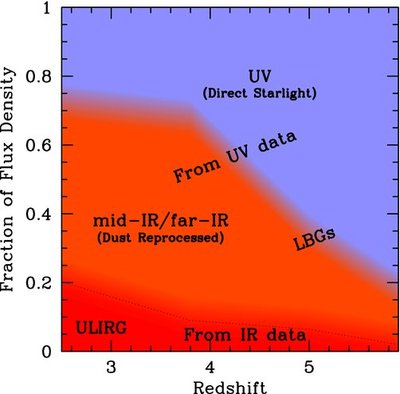
Caption: Figure 12.
Fraction of the total luminosity density from stars at
z ~ 2–6 emitted by galaxies in the rest-frame UV and in the mid-IR/far-IR (after dust reprocessing). In calculating the energy
output in the UV vs. IR, we adopt the extinction estimates in Table 5 and assume that the total energy output from ULIRGs
occurs in the infrared (see Section 6.3). A dotted line is included to show the relative contribution of LBGs and ULIRGs to
the mid-IR/far-IR energy output. The contribution of star-forming galaxies is included all the way down to zero luminosity.
Most of the energy output at
z ~ 2–4 would appear to occur in the IR, while at
z
 5 the energy output occurs mostly in the UV. Note that despite most of the energy output at
z~2.5–4 occurring at IR wavelengths, the SFR densities we derive from LBG surveys (after dust corrections) should account for
80% of the SFR density at
z
3 (see Figure
14).
5 the energy output occurs mostly in the UV. Note that despite most of the energy output at
z~2.5–4 occurring at IR wavelengths, the SFR densities we derive from LBG surveys (after dust corrections) should account for
80% of the SFR density at
z
3 (see Figure
14).
Other Images in This Article
Show More
Copyright and Terms & Conditions
© 2009. The American Astronomical Society. All rights reserved.

