

Image Details
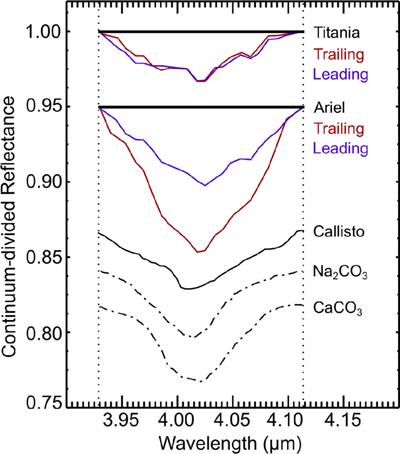
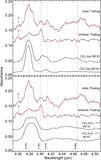
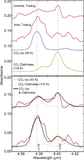
Caption: Figure 10.
Continuum-divided reflectance data showing 4 μm bands identified in the leading and trailing hemisphere data collected at Ariel and Titania (secure detections; Table 2), IRTF/SpeX data of Callisto’s leading hemisphere (originally reported in R. J. Cartwright et al. 2020b), and laboratory data of anhydrous sodium carbonate and calcium carbonate (R. A. Nyquist et al. 1997), with uncertainties removed and offset vertically for clarity. The 4 μm features identified in the G395M data and reported in Table 3 (3.96–4.11 μm) are slightly narrower than the feature identified on Callisto (3.92–4.11 μm). Consequently, we remeasured the 4 μm features in the G395M data of Titania and Ariel using the same wavelength range as Callisto’s 4 μm band, thereby enabling a more suitable comparison between these three moons.
Other Images in This Article
Copyright and Terms & Conditions
© 2026. The Author(s). Published by the American Astronomical Society.

