

Image Details
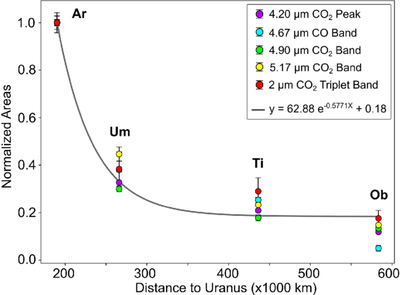
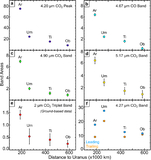
Caption: Figure 11.
Areas and approximate 1σ uncertainties for the 4.20, 4.67, 4.90, and 5.17 μm spectral features, measured by JWST/NIRSpec, and the CO2 triplet band, measured by IRTF/SpeX, for the trailing hemispheres of Ariel (“Ar”), Umbriel (“Um”), Titania (“Ti”), and Oberon (“Ob”), normalized to Ariel. These normalized measurements use the same colors as the corresponding measurements shown in Figure 4. A global, nonunique model (offset exponential) has been fit to the data to visually illustrate the comparable trends for each of these features as a function of distance from Uranus. The overall trend in band and peak areas demonstrates that CO2 and CO are concentrated on the trailing hemispheres of the inner moons, possibly more consistent with a charged particle irradiation origin and less so localized geologic exposure of CO2 on each moon.
Other Images in This Article
Copyright and Terms & Conditions
© 2026. The Author(s). Published by the American Astronomical Society.

