

Image Details
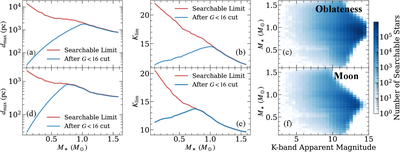
Caption: Figure 3.
Favorable star catalogs for detecting planetary oblateness (top) and moons (bottom) constructed under optimistic assumptions about planet/moon properties, viewing geometry, and JWST performance. The adopted detection threshold was Δχ2 = 60 using the ETC noise model. Panels (a) and (d) show the maximum search distance as a function of stellar mass. The solid curves show the formal distance limits, and the dashed curves show the revised limits after applying the G < 16 cut. Panels (b) and (e) show the corresponding limiting apparent K magnitudes. Panels (c) and (f) show the number of favorable stars in the (M⋆, K) plane.
Other Images in This Article
Show More
Copyright and Terms & Conditions
© 2026. The Author(s). Published by the American Astronomical Society.

