

Image Details
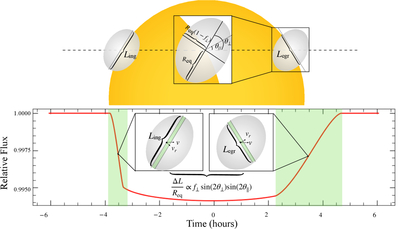
Caption: Figure 2.
Illustration of the ingress–egress asymmetry produced by an oblate planet. Top: transit geometry. The planet’s projected shape is elliptical, with projected flattening f⊥. The intersections of the ellipse with the stellar limb are nearly straight lines but with different lengths L, leading to different rates of ingress and egress. Bottom: example light curve (red) with exaggerated projected oblateness (f⊥ = 0.8). The resulting asymmetry between ingress and egress (green) underlies the geometric factor F used in our detectability metric (Appendix A).
Other Images in This Article
Show More
Copyright and Terms & Conditions
© 2026. The Author(s). Published by the American Astronomical Society.

Copyright ©
2026 Astronomy Image Explorer. All Rights Reserved.
