

Image Details
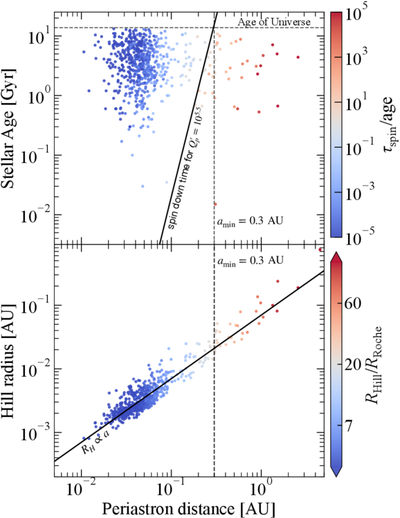
Caption: Figure 9.
Effects of relaxing the 0.3 au periastron distance. Top row: tidal despinning timescales for known transiting giant planets. Points show stellar age vs. periastron distance and are colored according to τspin/Age, where τspin is evaluated system by system, assuming ﹩{Q}_{p}^{{\prime} }=1{0}^{5.5}﹩. Solid curves show τspin for ﹩{Q}_{p}^{{\prime} }=1{0}^{5.5}﹩, assuming Jupiter-like planetary properties. The dashed horizontal line marks the age of the Universe, and the dashed vertical line marks the adopted 0.3 au cut. Bottom row: Hill sphere constraints for moons. Points show the planetary Hill radius as a function of periastron distance and are colored according to RHill/RRoche, with the Roche distance evaluated assuming a satellite density of 3 g cm−3. The color scale is centered at RHill/RRoche = 20, motivated by the fact that most large regular satellites in the solar system orbit within 0.05 RHill. The adopted 0.3 au cut is conservative: some systems at smaller periastron distances may retain measurable rotational oblateness or have large enough Hill radii for long-lived moons.
Other Images in This Article
Show More
Copyright and Terms & Conditions
© 2026. The Author(s). Published by the American Astronomical Society.

