

Image Details
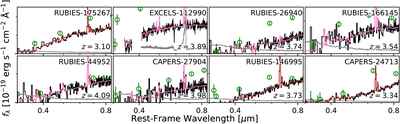
Caption: Figure A2.
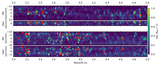
Eight NIRSpec spectra (black) and best-fit Prospector models for galaxies with ﹩\mathrm{log}({M}_{* }/{M}_{\odot })\,\geqslant \,10.5﹩, τdust ≥ 1.5, and either ﹩\mathrm{log}({\rm{sSFR}}/{{\rm{yr}}}^{-1})\lt -10﹩ (red) or ﹩\mathrm{log}({{\rm{sSFR}}}_{16}/{{\rm{yr}}}^{-1})\lt -10﹩ (pink). Unlike Figures 1 and A1, here we leave the spectra uncalibrated and show the model spectrum scaled to the observed instead. Based on their high dust optical depths, we classify them as “dusty star-forming galaxies” by default, though classifying them as quiescent leaves our conclusions unchanged.
Other Images in This Article
Show More
Copyright and Terms & Conditions
© 2026. The Author(s). Published by the American Astronomical Society.

Copyright ©
2026 Astronomy Image Explorer. All Rights Reserved.
