

Image Details
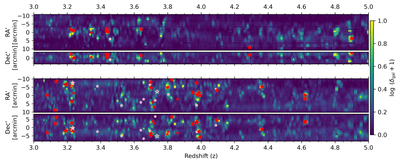
Caption: Figure 5.
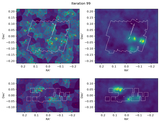
Cross sections of the 3 < z < 5 density grids in the EGS (top) and UDS (bottom) fields with redshift along the x-axis and decl.﹩{}^{{\prime} }﹩ and R.A.﹩{}^{{\prime} }﹩ on the y-axes. The locations of the quiescent galaxies from Section 3 are indicated by larger red stars, and marginally quiescent galaxies by pink stars. Open stars correspond to the photometry-only fits in Section 3.3. Smaller red (pink) stars show the positions of ﹩10\,\leqslant \,\mathrm{log}({M}_{* }/{M}_{\odot })\lt 10.5﹩ (marginally) quiescent galaxies. Several previously identified overdensities are immediately recognizable: in UDS, the z = 3.2 overdensity in UDS around ZF-UDS-7329 (C. K. Jespersen et al. 2025; C. Turner et al. 2025; L. Kawinwanichakij et al. 2026), the z = 4.6 overdensity around EXCELS-117560 and EXCELS-109760 (A. C. Carnall et al. 2024; C. K. Jespersen et al. 2025); in EGS, the Cosmic Vine at z = 3.4 (S. Jin et al. 2024; K. Ito et al. 2025; N. B. Sillassen et al. 2026) and the overdensity around the z = 4.9 quiescent galaxy RUBIES-EGS-QG1 (S. M. Urbano Stawinski et al. 2024a; A. de Graaff et al. 2025a). Remarkably, almost all spectroscopically confirmed quiescent galaxies seem to be found in or near an overdensity.
Other Images in This Article
Show More
Copyright and Terms & Conditions
© 2026. The Author(s). Published by the American Astronomical Society.

