
Image Details
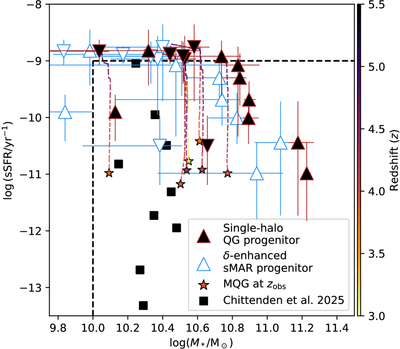
Caption: Figure 12.
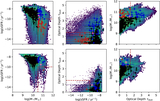
A comparison of the 15 quiescent galaxy single-halo progenitors (black triangles with red outlines; upright triangles denote overdensity MQG progenitors, downturned triangles are field MQG progenitors) with ﹩\mathrm{log}({M}_{* ,84}/{M}_{\odot })\gt 10﹩ and ﹩\mathrm{log}({\mathrm{sSFR}}_{16}/{\mathrm{yr}}^{-1})\lt -9﹩ at z = 5.5 with the nine simulated quiescent galaxies from the THESAN simulation (H. G. Chittenden et al. 2026; black squares). Blue-outlined white triangles show the MQG progenitor population when mergers are allowed and enhanced by δgal. Of the eight MQG SHPs with median stellar mass and sSFR in the quiescent region (black dashed square), seven are found in overdensities. MQG SHPs often have either higher stellar masses or sSFRs compared to the simulated quiescent galaxies. The density-enhanced merger model progenitors are lower mass than the SHPs, but in the most extreme cases are still more massive than the simulated quiescent galaxies in THESAN.
Other Images in This Article
Show More
Copyright and Terms & Conditions
© 2026. The Author(s). Published by the American Astronomical Society.

