

Image Details
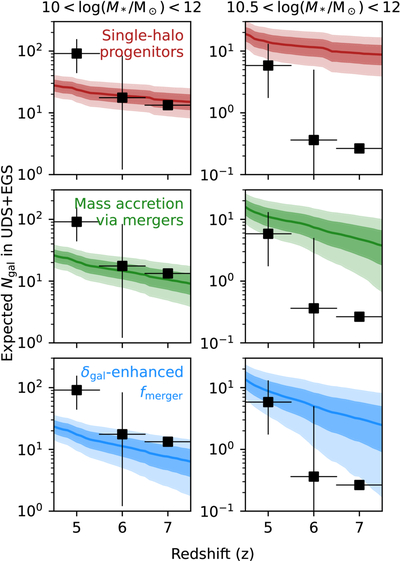
Caption: Figure 11.
Expected numbers of ﹩10\lt \mathrm{log}({M}_{* }/{M}_{\odot })\lt 12﹩ (left) and ﹩10.5\lt \mathrm{log}({M}_{* }/{M}_{\odot })\lt 12﹩ (right) galaxies at z = 5, 6, and 7 from the integrated galaxy SMF in A. Weibel et al. (2024; black squares) and the SFHs of the MQGs in this work under different stellar mass assembly assumptions (colored bands; the line shows the median, and dark/light bands show 1σ/2σ confidence intervals). In the first case (red), we assume all of a quiescent galaxy’s stellar mass is formed in situ in a single progenitor halo. Above the knee of the SMF (﹩\mathrm{log}({M}_{* }/{M}_{\odot })\gt 10.5﹩), the number of expected MQG progenitors far exceeds the observed number counts. The green band shows the number counts of primary quiescent galaxy progenitors under the assumption that all primaries grow via mergers, quantified by a redshift-dependent specific mass-accretion rate (Q. Duan et al. 2025). Finally, the blue band shows how introducing a dependence on local environment δgal to the merger fraction (and therefore the sMAR) further reduces the inferred number of high-mass primary progenitors and produces better agreement with high-z observations.
Other Images in This Article
Show More
Copyright and Terms & Conditions
© 2026. The Author(s). Published by the American Astronomical Society.

