

Image Details
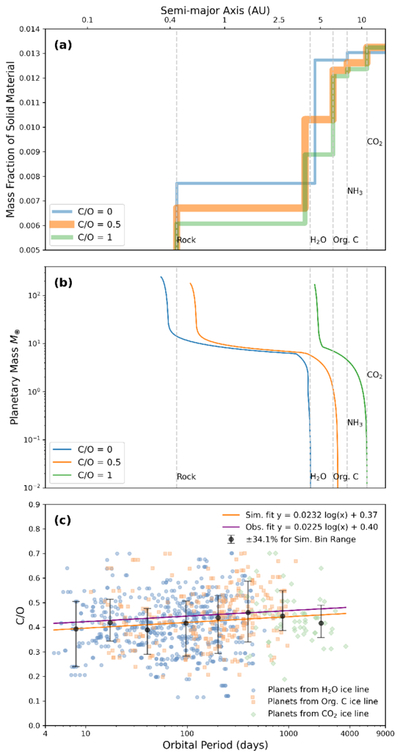
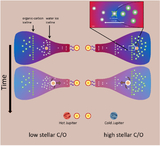
Caption: Figure 7.
Impact of stellar C/O ratio on solid material distribution, formation and migration of giant planet, and C/O–orbital period trend. (a) Mass fraction of solid material as a function of the radial distance from the central star with three characteristic stellar C/O of 0, 0.5, and 1, respectively. The vertical dashed lines refer to the major ice lines of silicate, water, organic carbon, ammonia, and carbon dioxide from left to right. (b) Growth and migration of giant planets where the birth protoplanets of 10−2 M⊕ are initiated at different species of ice lines according to the stellar C/O ratios. (c) Stellar C/O vs. planetary orbital period from population synthesis models. Blue, orange, and green points represent planets formed near the H2O, organic carbon, and CO2 ice lines, respectively. The orange and purple lines denote the best-fit relations from simulations and observations.
Other Images in This Article
Show More
Copyright and Terms & Conditions
© 2026. The Author(s). Published by the American Astronomical Society.

