

Image Details
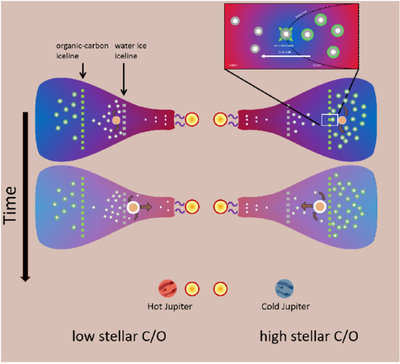
Caption: Figure 6.
Schematic illustration of how the C/O ratio of host stars regulates the formation, migration, and final orbital periods of giant planets. In the left panel (low stellar C/O case), the solid material is more concentrated in the inner oxygen-rich disk region, and the protoplanet is more likely to form near the water (H2O) ice line via streaming instability. It subsequently undergoes inward migration by accreting solids and gas, ultimately forming a hot giant planet with a short orbital period. In the right panel (high stellar C/O case), the protoplanet forms at the farther out disk region near the organic carbon and carbon dioxide ice line. After moderate inward disk migration, the planet ends up as a giant planet with a relatively long orbital period.
Other Images in This Article
Show More
Copyright and Terms & Conditions
© 2026. The Author(s). Published by the American Astronomical Society.

