

Image Details
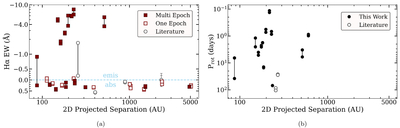
Caption: Figure 16.
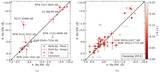
The Hα activity (a) and rotation rate (b) of our Results Sample binary components shown vs. their physical separations, using values from Table 1, Table 3, Table 6, and C25. A single marker is one star, and each twin pair is connected by a vertical black line. Panel (a): the y-axis is scaled linearly between −0.5 and +0.5 and logarithmically outside these bounds, with stronger emission moving upward on the plot. Blue labels indicate the regions of Hα abs(orption) and emis(sion). All squares are measurements from CHIRON, while circles are from literature sources, and solid squares show those with multiple CHIRON epochs using their mean EWs. The range of observed EWs for multiepoch cases are not shown for visual clarity. The CHIRON results shown here only include nonflaring epochs with both stars successfully observed back to back. Panel (b): a faster rotation period moves upward on the plot, to track with stronger emission in panel (a). For RTW 0409+4623 AB, we assign A the 2.55 day period and B the 2.24 day period for plotting purposes. The two plots reveal no obvious trends between the component pairs’ physical separations and their differences in activity or rotation, indicating dynamical interactions between the wide components are likely not significantly impacting their rotation–activity behaviors.
Other Images in This Article
Show More
Copyright and Terms & Conditions
© 2026. The Author(s). Published by the American Astronomical Society.

