

Image Details
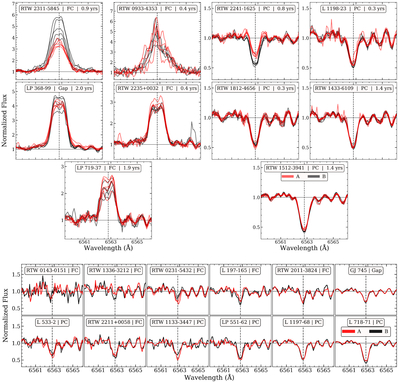
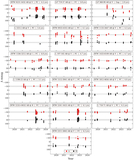
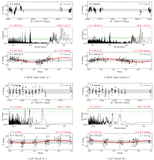
Caption: Figure 5.
Spectra of the Hα region for 22 New Systems observed by CHIRON, excluding the known or suspected non-twin higher-order multiple systems. Each individual spectrum has been blaze corrected and shifted to the rest frame based on the measured stellar RVs. These plots only include epochs with both stars successfully observed back to back and with neither flaring. Each subplot compares the A star in red and its twin B star in black; cases with multiple epochs are shown stacked. The top grid of 10 pairs shows “core” targets, where each system has five epochs, except RTW 0933–4353 AB with four epochs. These multiepoch cases are split into emission systems on the left (with changing y-axis scales) and absorption systems on the right. The bottom grid shows the remaining 12 non-core pairs observed at only one or two epochs. Titles in each subplot specify the binary system shown and their interior structure (PC/FC/Gap); those in the top grid also give the time baseline of their multiple epochs. It is remarkable how well-matched many pairs appear, even over multiple epochs of variability, but some key systems show sustained differences in Hα strength.
Other Images in This Article
Show More
Copyright and Terms & Conditions
© 2026. The Author(s). Published by the American Astronomical Society.

