

Image Details
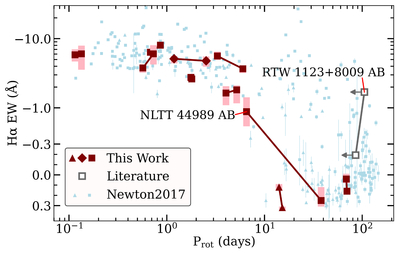
Caption: Figure 14.
Twin binaries from our Results Sample shown in the rotation–activity plane for M dwarfs, with lines connecting the two twin components in each binary. The Hα EW scale is linear between 0.3 and −0.3 and logarithmic beyond this range. Mean measurements are from Table 3, Table 6, and C25. The CHIRON Hα EWs include only nonflaring epochs with both stars successfully observed back to back, and shaded bars show the ranges of observed EWs. Square symbols represent fully convective stars, triangles are partially convective, and diamonds specify the LP 368–99 AB system residing within the gap between these structural types (see Section 11.5). Comparison data for a large sample of field M dwarfs from N17 are underplotted in blue, and these points use the same PC/FC symbol scheme based on their estimated masses relative to 0.35 M⊙. The two significantly mismatched twin pairs are (1) NLTT 44989 AB from C25, and (2) RTW 1123+8009 AB using Hα EWs from P24 and rotation periods from L24. It is notable that all of the stars generally follow the rotation–activity relationship, even for NLTT 44989 AB, where the slower rotator is correspondingly less active. The single exception is RTW 1123+8009 AB, which has rotation period measurements that are less confident and possibly somewhat inaccurate, hence the arrows plotted on its points (see Section 8.3.7).
Other Images in This Article
Show More
Copyright and Terms & Conditions
© 2026. The Author(s). Published by the American Astronomical Society.

