

Image Details
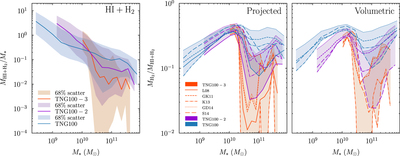
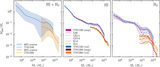
Caption: Figure 11.
Convergence with mass resolution of the neutral gas fraction (left) and the ﹩{M}_{{{\rm{H}}}_{2}}/{M}_{{\rm{H}}{\rm{I}}+{{\rm{H}}}_{2}}﹩ ratio (center and right) as a function of stellar mass. The blue lines and shaded areas show the TNG100 simulations, and the purple and red lines show the lower-resolution counterparts TNG100-2 and TNG100-3, respectively. The neutral gas fraction is converged only to a factor of about three at fixed mass between the resolution levels, meaning that the atomic and molecular fractions of stellar mass will be equally affected. Thus, instead of showing the fraction with respect to stellar mass, we consider the ratio of ﹩{{\rm{H}}}_{2}﹩ and neutral gas, both for the projection-based (center) and volumetric (right) versions of our H I/﹩{{\rm{H}}}_{2}﹩ models. Comparing the TNG100 and TNG100-2 lines for each model, they are also converged to about a factor of two to three for most stellar masses. In TNG100-3, the convergence gets significantly worse.
Other Images in This Article

Show More
Copyright and Terms & Conditions
© 2018. The American Astronomical Society. All rights reserved.

