

Image Details
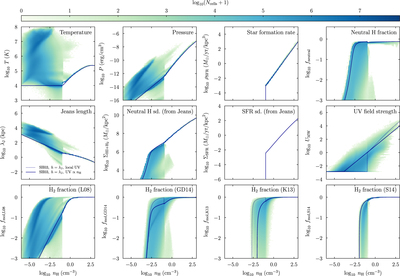
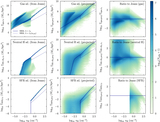
Caption: Figure 1.
Physical conditions and the resulting molecular fractions as a function of density. In each panel, the histograms show the distribution of all gas cells in the analyzed galaxies in TNG100, about 1.2 billion cells. The solid blue lines represent the ISM model of SH03 (Section 2.2.1). Top row: At densities below the star formation threshold of ﹩{n}_{{\rm{H}}}=0.106\ {\mathrm{cm}}^{-3}﹩, hydrodynamics governs the state of the gas, leading to a range of temperatures and pressures. To guide the eye, the blue lines correspond to an ideal-gas equation of state with a temperature of 10,000 K. Above the threshold, the SH03 effective equation of state determines the temperature, pressure, and SFR. The top right panel shows the fraction of gas in neutral hydrogen, which is computed from the model of Rahmati et al. (2013a) below the star formation threshold (assuming Z = Z⊙) and as the cold cloud fraction in the SH03 model above the threshold (Section 2.2.2), introducing a slight discontinuity. Middle row: the most important ingredients used in the cell-by-cell modeling of the H I/﹩{{\rm{H}}}_{2}﹩ transition (Section 2.3), namely the Jeans length, the surface densities of neutral hydrogen and star formation, and the UV field strength. The surface densities are computed by multiplying the respective volume densities by the Jeans length. The UV field is estimated from optically thin propagation (Section 2.4) and approximated as ﹩{U}_{\mathrm{MW}}\propto {n}_{{\rm{H}}}﹩ in the solid blue lines. Bottom row: the predicted molecular fraction according to the various H I/﹩{{\rm{H}}}_{2}﹩ models (the GK11 predictions are very similar to that of GD14). For comparison, the dotted lines show an alternative UV model where ﹩{U}_{\mathrm{MW}}﹩ is equal to the UV background below the star formation threshold and proportional to the SFR surface density above the threshold. This assumption tends to introduce an unphysical dip in ﹩{f}_{\mathrm{mol}}﹩ at the star formation threshold (though it has no impact on the L08 model, which does not depend on the UV field). However, even with the new modeling of the UV field, the star formation threshold introduces a slight discontinuity into many of the computed quantities, including the molecular fractions.
Other Images in This Article
Show More
Copyright and Terms & Conditions
© 2018. The American Astronomical Society. All rights reserved.

