

Image Details
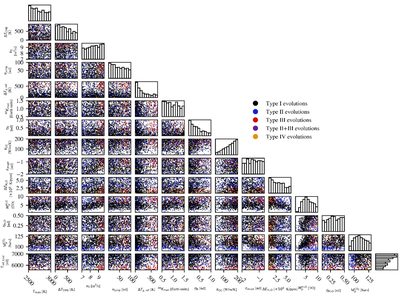
Caption: Figure 8.
Initial parameter choices for all evolutions that reproduce Venus in a space defined by all of our varied parameters: the temperature jump across the core–mantle boundary (ΔTCMB), the reference viscosity (νref), the jump in viscosity from the upper to the lower mantle (νjump), the core liquidus depression (ΔTχ,ref), the amount of potassium-40 in the mantle (40Kman), the amount of potassium-40 in the core expressed as a fraction of how much is in the mantle (ηK), the thermal conductivity of the outer core (kOC), the eruption efficiency (ϵerupt), the depression of the viscosity activation energy due to water (﹩{\rm{\Delta }}{E}_{{{\rm{H}}}_{2}{\rm{O}}}﹩), the amount of water the planet formed with (﹩{M}_{p}^{{{\rm{H}}}_{2}{\rm{O}}}﹩), the fraction of that water that is initially in the planet’s atmosphere (﹩{\eta }_{{{\rm{H}}}_{2}{\rm{O}}}﹩), the initial amount of carbon dioxide in the planet’s mantle (﹩{M}_{p}^{{{\rm{CO}}}_{2}}﹩), the reference core liquidus temperature (Tref,Lind), and the initial average temperature of the mantle (Tm). Each simulation is color-coded based on the identified evolutionary type described in the text. The histograms show the distribution of all simulations marginalized over all variables except for each variable below them.
Other Images in This Article
Show More
Copyright and Terms & Conditions
© 2026. The Author(s). Published by the American Astronomical Society.

