

Image Details
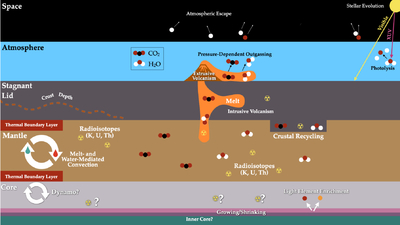
Caption: Figure 1.
Illustration of the processes implemented in our model. Mantle convection is lubricated via the presence of water and melt; the vigor of the viscosity thus sets the boundary of the nonadiabatic thermal boundary layer and above that the conductive stagnant lid lithosphere, which consists of both a mantle and crust layer. Melting in the mantle transports radioisotopes and volatiles to the crust and atmosphere, where water is photolyzed and escapes. Radioisotopes and volatiles trapped in the crust due to intrusive volcanism are recycled back into the mantle through crustal delamination. The core is potentially heated by radioisotopes and cooled by convection with a vigor controlled by the temperature differential between the core–mantle boundary and the lower mantle. A cool enough core could potentially result in inner-core solidification, which, together with high enough convective vigor, can result in the generation of a core dynamo and planetary magnetic field. As the core solidifies, the outer core is enriched in light elements, resulting in a decrease in the outer core liquidus temperature.
Other Images in This Article
Show More
Copyright and Terms & Conditions
© 2026. The Author(s). Published by the American Astronomical Society.

