

Image Details
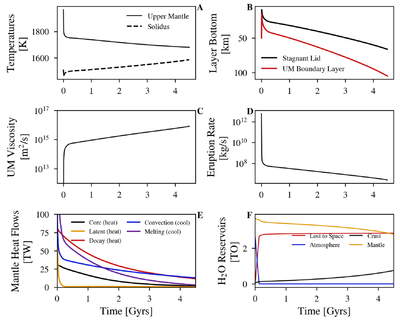
Caption: Figure 9.
Time evolution of select key mantle variables for a sample evolution with Type I behavior. Panel (A) plots the upper mantle and solidus temperatures over time; panel (B) shows the depth to the bottom of the stagnant lid layer and the upper mantle thermal boundary layer; panel (C) shows the upper mantle viscosity; panel (D) shows the eruption rate; panel (E) shows the different heat sources and sinks (cooling mechanisms) for the mantle; and panel (F) shows the evolution of the water reservoirs in the simulation. Note that all of these variables evolve rather stably after short transient behavior at the beginning of the simulation. As the planet cools, the stagnant lid and thermal boundary layer slowly increase, which causes the solidus temperature and eruption rate to slowly decrease. Most of the water is lost to space during the early transient stage, with the rest sequestered in the crust and mantle. Parameter choices for this evolution can be found in Table 6.
Other Images in This Article
Show More
Copyright and Terms & Conditions
© 2026. The Author(s). Published by the American Astronomical Society.

