

Image Details
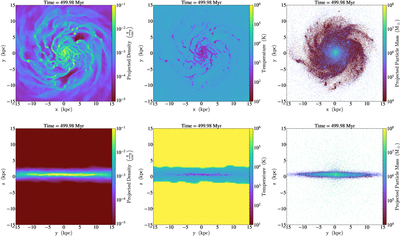
Caption: Figure 9.
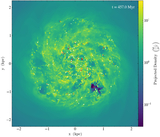
Final snapshot (t = 499.98 Myr) of the AGORA galaxy simulation using Enzo, without stellar feedback. Each panel is centered on the simulation domain and covers a width of 30 kpc. Columns display density (left), density-squared-weighted temperature (center), and particle distributions annotated with dark matter clump and star particle masses (right), including those formed during the simulation and those present in the initial condition. The top and bottom rows show face-on and edge-on projections, respectively. We closely monitor the dynamics of galaxy formation by calling libyt Python data analysis routine every 0.5 Myr. The resulting figures are then combined into a 50 s animation that shows the sequence from 0–499.49 Myr. The animation illustrates the evolution from the initial gas and dark matter distribution to the formation of a rotationally supported disk galaxy with spiral structure. This approach enables high-temporal-resolution monitoring of galaxy formation without compromising spatial resolution or requiring substantial disk storage.
(An animation of this figure is available in the online article.)
(An animation of this figure is available.)
The video/animation of this figure is available in the online journal.
Other Images in This Article
Show More
Copyright and Terms & Conditions
© 2026. The Author(s). Published by the American Astronomical Society.

