

Image Details
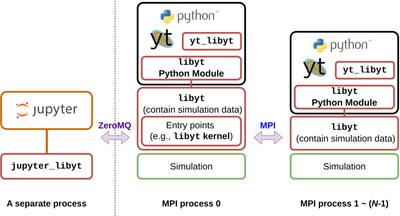
Caption: Figure 1.
The overall structure of libyt and all of the related components: libyt Python Module, libyt kernel, yt_libyt, and jupyter_libyt, that are built around it to integrate simulations with Python, yt, and Jupyter. Although libyt can run arbitrary Python scripts, we focus on its use with yt. The library provides an API for binding simulation data and functions to Python, invoking analysis routines, and enabling entry points, such as the libyt kernel for Jupyter Notebook. During in situ analysis, the original simulation processes pause and wait until Python completes all jobs. A Jupyter Notebook running in a separate process connects to the libyt kernel via ZeroMQ via the jupyter_libyt extension, with all Python interpreters and simulations working synchronously under the Message Passing Interface (MPI) task space. The details of each component are described in Section 2.1.
Other Images in This Article





Show More
Copyright and Terms & Conditions
© 2026. The Author(s). Published by the American Astronomical Society.

