

Image Details
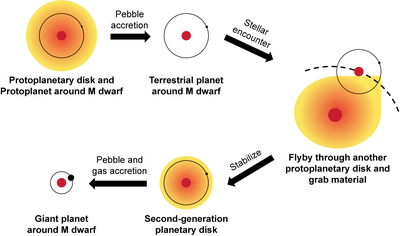
Caption: Figure 1.
Evolutionary pathway of a giant planet around an M dwarf through FISA. The formation process initiates with classical core accretion within the protoplanetary disk of the M dwarf, leading to the formation of a terrestrial planet. By this stage, the original protoplanetary disk has become highly tenuous or fully dissipated. Subsequently, the M dwarf and its planetary companion undergo a flyby with the protoplanetary disk of a young star, capturing significant material that rapidly stabilizes into a new planetary disk around the M dwarf. The preexisting planet reinitiates core accretion, rapidly reaches pebble isolation mass, and undergoes gas accretion to evolve into a giant planet. During these two accretion phases, the planet experiences two episodes of inward migration, ultimately resulting in its final close-in orbit around the M dwarf.
Other Images in This Article
Copyright and Terms & Conditions
© 2026. The Author(s). Published by the American Astronomical Society.

