

Image Details
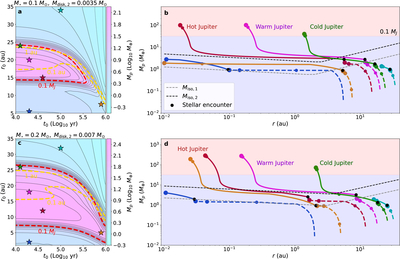
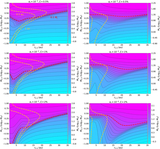
Caption: Figure 3.
Evolutionary paths of protoplanets around M dwarfs via two stages of accretion. (a) Final state of the protoplanet in the scenario where the mass of the central star M⋆ = 0.1 M⊙, the mass of the first-generation disk Mdisk,1 = 0.0075 M⊙, and mass of the second-generation disk Mdisk,2 = 0.0035 M⊙. The horizontal axis indicates the formation time of the protoplanet, and the vertical axis indicates its initial orbital radius. The color code represents the final mass of the planet MP after the completion of the second accretion. The red dashed line represents the contour of MP = 0.1MJ, and the gold dashed lines are contours corresponding to the final orbital radii of 0.1 and 1 au. (b) Exemplary evolution pathways of protoplanets with different initial conditions, as indicated by star signs with corresponding colors in (a). The gray and black dashed lines represent the pebble isolation mass of the first- and second-generation disks, respectively. Color dashed lines correspond to the growth in the first-generation disk, and solid lines correspond to that in the second-generation disk, where the initial conditions are marked with corresponding color-coded asterisks in (a). The time span between dots on each growth path is 1 Myr. Black dots mark the position and mass of the terrestrial planets formed through first-stage accretion at the time of the disk flyby. Taking 0.1 MJ as the threshold, the red, purple, and green curves illustrate the evolution pathways of a hot Jupiter, a warm Jupiter, and a cold Jupiter, respectively. (c) and (d) present results of the same analysis as in (a) and (b), respectively, but with a more massive M dwarf of 0.2 M⊙, a corresponding first-generation disk of Mdisk,1 = 0.015 M⊙, and a captured second-generation disk of Mdisk,2 = 0.007 M⊙.
Other Images in This Article
Copyright and Terms & Conditions
© 2026. The Author(s). Published by the American Astronomical Society.

