

Image Details
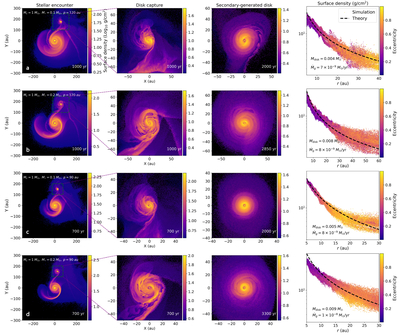
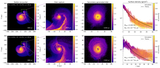
Caption: Figure 2.
Two-dimensional simulations of the flyby of an M dwarf system through a protoplanetary disk. The total mass of the protoplanetary disk is 0.12 M⊙, with a 1 M⊙ central star. Four sets of parameters are considered as initial conditions: (a) disk radius Rd = 150 au, mass of the M dwarf M⋆ = 0.1 M⊙, flyby distance d = 120 au; (b) Rd = 150 au, M⋆ = 0.2 M⊙, d = 120au; (c) Rd = 100 au, M⋆ = 0.1, M⊙, d = 90 au; (d) Rd = 100 au, M⋆ = 0.2 M⊙, d = 90 au. The first column illustrates the gas distribution in the entire system ∼2–3 kyr after the flyby. The second column are zoomed-in views of the snapshots in the first column, showing the distribution of captured gas by the M dwarf. The third column shows the morphology of the second-generation disk around the M dwarf after stabilization of the captured material. The fourth column presents gas surface density against distance to the M dwarf in the resulting second-generation disk. The black dashed curves denote the theoretical profile (Appendix A.1) with a logarithmic slope of surface density versus radius being −15/14. The color code indicates orbital eccentricity.
Other Images in This Article
Copyright and Terms & Conditions
© 2026. The Author(s). Published by the American Astronomical Society.

