

Image Details
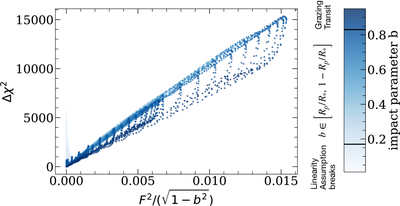
Caption: Figure B.1.
Validation of the analytic geometric scaling for oblateness detectability. Each point shows a simulated configuration for a Jupiter-like planet transiting a 0.60 R⊙ star, plotted as the oblateness-model preference Δχ2 vs. the combined geometric predictor ﹩{F}^{2}/\sqrt{1-{b}^{2}}﹩, where F ≡ F(f⊥, θ⊥, b) is the dimensionless ingress–egress asymmetry factor. Points are colored by impact parameter. For nongrazing and noncentral transits, Δχ2 increases approximately linearly with the predicted scaling. The relation breaks down for central transits, where the ingress–egress asymmetry is suppressed, and for grazing transits, where finite-planet-size effects reduce the asymmetry. For this system, these regimes occur at b ≲ 0.17 and b ≳ 0.83, indicated by the markers on the color bar.
Other Images in This Article
Show More
Copyright and Terms & Conditions
© 2026. The Author(s). Published by the American Astronomical Society.

