

Image Details
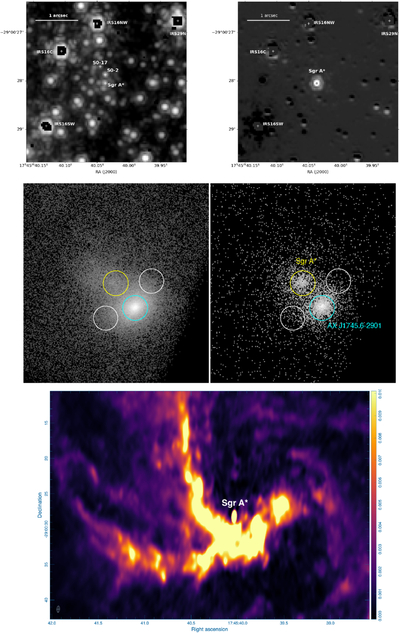
Caption: Figure 1.
(Top) The normal stellar field at 2.1 μm of NIRCam of JWST surrounding Sgr A* (left), and a version that has had a baseline image (when Sgr A* was not flaring) subtracted from it (right). This allows Sgr A* to be seen without the overlapping nearby stars. Note that the cores of bright stars in the field, such as the IRS 16 members and IRS 29N, are saturated and hence appear black. (Middle) X-ray images showing 34″.7 extraction circles around Sgr A* (yellow), the nearby bright low-mass X-ray binary (LMXB) AX J1745.6-2901 (cyan), and the background regions used for Sgr A* (white, chosen to be equidistant from the LMXB as Sgr A*). The images show when Sgr A* is not flaring (left) and when it is flaring (right, shorter 1000 s exposure time). (Bottom) A VLA image of the inner ∼30″ × 40″ of Sgr A* showing the minispiral ionized gas at 34 GHz, taken simultaneously on 2024 April 5. The bright compact source is Sgr A*. At this frequency the quiescent flux dominates over the variable emission.
Other Images in This Article
Show More
Copyright and Terms & Conditions
© 2026. The Author(s). Published by the American Astronomical Society.

