

Image Details
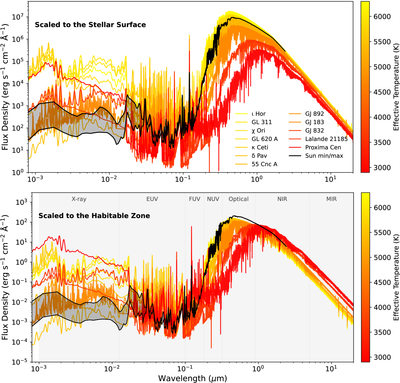
Caption: Figure 3.
Panchromatic SEDs of the sample stars compared to the Sun. Stellar SEDs are color coded by effective temperature, while the solar spectrum is shown in black. The shaded region indicates the range of solar fluxes observed over the solar activity cycle. Solar reference spectra are derived from measurements obtained by the Thermosphere Ionosphere Mesosphere Energetics and Dynamics (TIMED) Solar EUV Experiment (SEE) (T. N. Woods et al. 2005; Laboratory for Atmospheric and Space Physics 2005). Top panel: flux densities scaled to the stellar surface to enable direct comparison of intrinsic high-energy emission levels. Bottom panel: flux densities scaled to the HZ distance of each system, illustrating the high-energy radiation environments experienced by potentially habitable planets. The majority of the sample stars exhibit XUV flux levels that exceed those of the Sun, even when compared to solar maximum conditions, indicating elevated high-energy radiation environments relative to the present-day Sun.
Other Images in This Article
Copyright and Terms & Conditions
© 2026. The Author(s). Published by the American Astronomical Society.

