

Image Details
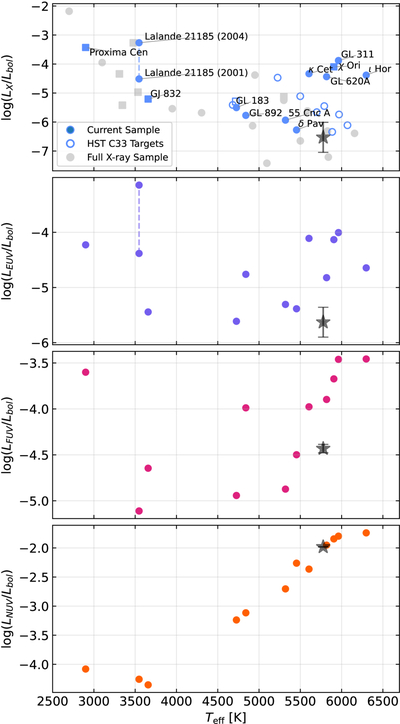
Caption: Figure 4.
Fractional high-energy luminosities of the sample stars as a function of effective temperature. The Sun is shown as a black star symbol, with vertical error bars indicating the range of solar emission over the activity cycle. In the top panel, gray points show the full comparison sample of stars with X-ray measurements from B. A. Binder et al. (2024). Circles denote targets included in the TSS25 sample, while squares indicate stars present only in ExoCat. Open symbols indicate targets with planned FUV and/or NUV observations in HST Cycle 33. The majority of the current sample exhibits fractional X-ray and EUV luminosities approximately 1–2 orders of magnitude higher than solar values, although a small number of targets are consistent with solar levels. The FUV luminosities of solar-type stars are generally comparable to, but slightly elevated relative to, solar values. For Lalande 21185, two quiescent APEC models from Schwieterman et al. (in preparation) are used to construct separate SEDs, which are reflected in the X-ray and EUV panels. More broadly, the sample exhibits measurable X-ray variability (B. A. Binder et al. 2024), with Proxima Centauri and GJ 832 varying by approximately an order of magnitude (comparable to Lalande 21185), while the remaining targets show more modest variability at the ∼0.5 dex level.
Other Images in This Article
Copyright and Terms & Conditions
© 2026. The Author(s). Published by the American Astronomical Society.

