

Image Details
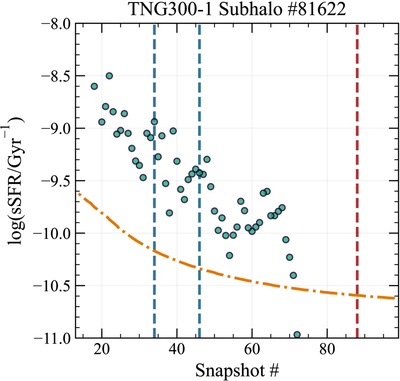
Caption: Figure 3.
Shown here is the specific star formation rate and mass history of a TNG300-1 subhalo in our sample. The dashed lines show the snapshots in the simulation where the subhalo underwent a major merger (i.e., qgal ≥ 1/3). For our core scouring model we label a merger gas-rich (wet) if an episode of star formation occurs during or any time after the merger. Conversely, if during and after a merger sSFR < 1/3tH the merger is labeled gas-poor (dry). Here tH is the Hubble time (orange dashed–dotted curve) at the corresponding redshift. It is only the dry mergers in our model that contribute to core scouring. For this example subhalo, only the most recent major merger is considered dry (red dashed line). The preceding mergers induced bursts of star formation, and count as wet mergers (blue dashed lines). Therefore, the wet merger at snapshot 46 would be the first merger considered in the analysis of this subhalo, used to set the inner logarithmic density slope λp (9). Core scouring would then take place during the subsequent dry merger at snapshot 88, altering the shape of the nuclear profile.
Other Images in This Article
Copyright and Terms & Conditions
© 2026. The Author(s). Published by the American Astronomical Society.

