

Image Details
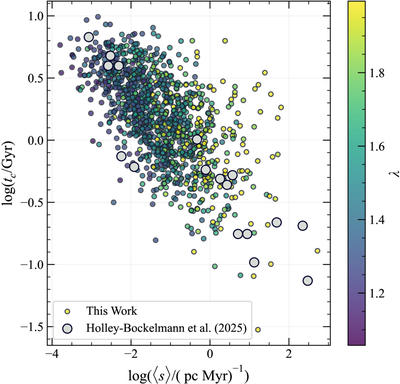
Caption: Figure 9.
Coalescence time plotted against the average binary hardening parameter, s = d(1/a)/dt. Small circles show binaries from our best-fit semianalytic model, with colors indicating the inner logarithmic slope of the postscouring density profile, λ (see Equation (21)), immediately after coalescence. Large circles show a subset of binaries from the high-resolution, gas-free, direct N-body simulations of K. Holley-Bockelmann et al. (2025), which include nonzero initial eccentricities and prograde binary orbits relative to the host galaxy rotation. These simulations initialize binaries at separations of ∼102–103 pc, substantially smaller than the typical initial separations of ∼10 kpc in our model, and therefore yield systematically shorter total coalescence times. Since tc depends on the integral of the hardening history (including the dynamical friction stage) the agreement between the models, despite very different methods and initial conditions, suggests that in gas-poor major mergers the coalescence timescale is largely regulated by the stellar-hardening phase once the binary reaches the Galactic center.
Other Images in This Article
Copyright and Terms & Conditions
© 2026. The Author(s). Published by the American Astronomical Society.

