

Image Details
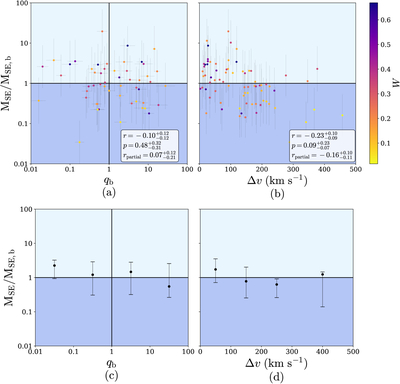
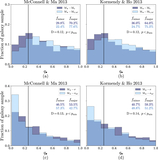
Caption: Figure 4.
The ratio of the SMBH mass calculated from the single-epoch virial method MSE from Equation (3) to the SMBH mass MSE,b calculated from Equation (5) for AGN hosts in close pairs versus the galaxy bulge stellar mass ratio qb and the velocity separation Δv between the galaxies in a pair. The top panels (a) and (b) show each data point with a color scale to show the galaxy merger probability from Equation (1a). The Pearson’s r correlation coefficients are shown in boxes in the bottom-right corners, with the probability-weighted r, the associated p-value, and the partial correlation coefficient rpartial, with Mb,AGNhost as the confounding variable. The light blue and dark blue regions show where the single-epoch SMBH mass (our ground truth) is greater than and less than the SMBH mass estimate based on stellar bulge mass, respectively. The bottom panels (c) and (d) show the results binned by the x-axis and spaced for clarity, with the data points as the probability-weighted average offset and the error bars as the 16th and 84th percentiles, as described in Table 5. From this figure, we can see that overmassive SMBHs preferentially exist in secondary bulges in more minor mergers and in more closely separated pairs.
Other Images in This Article
Copyright and Terms & Conditions
© 2026. The Author(s). Published by the American Astronomical Society.

