

Image Details
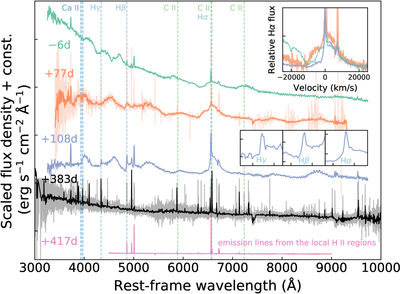
Caption: Figure 2.
Spectroscopic evolution of SN 2018bsz. The −6 day spectrum is taken from J. P. Anderson et al. (2018). The Balmer lines have emerged by +77 days in our WiFeS spectrum (the darker line has been rebinned to 20 Å). Interestingly, a strong asymmetry in the line profiles of all Balmer lines (see lower inset panels for zoom) appears in the +108 day EFOSC2 spectrum. This spectrum was previously presented by M. Pursiainen et al. (2022). No SN trace has been detected in the +383 day X-Shooter spectrum (the darker line has been binned to 5 Å). The +417 day spectrum was extracted from the MUSE cube at the SN position. After subtracting the stellar continuum, we highlight the strong narrow emission lines from the local H II regions (pink line). The upper inset shows a zoom-in around Hα, where the flux has been scaled to match the same continuum level as on the red side of the line. The spectra shown in this figure are provided as Data behind the Figure.
(The data used to create this figure are available in the online article.)
(The data used to create this figure are available.)
Other Images in This Article
Show More
Copyright and Terms & Conditions
© 2026. The Author(s). Published by the American Astronomical Society.

