

Image Details
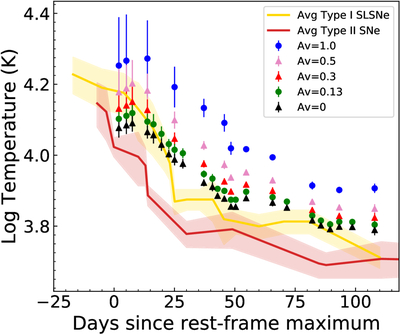
Caption: Figure A1.
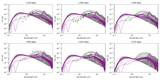
Temperature evolution of SN 2018bsz in comparison to the average evolution of SLSNe I and SNe II (C. Inserra et al. 2018b). The comparison samples comprise 14 SLSNe I (C. Inserra et al. 2013; M. Nicholl et al. 2015) and ∼30 SNe II (A. Elmhamdi et al. 2003; K. Maguire et al. 2010; C. Inserra et al. 2011, 2012; M. T. Botticella et al. 2010; L. Tomasella et al. 2013; C. P. Gutiérrez et al. 2017b). The shaded regions represent the 99.73% confidence ranges for the temperature of each class of SNe. The temperature of SN 2018bsz is measured from SED fits, assuming a blackbody at selected epochs. We find that if the host extinction is between AV = 0.1 and 0.3 mag, we obtain reasonable agreement with the SLSNe at 3–20 days after the peak.
Other Images in This Article
Show More
Copyright and Terms & Conditions
© 2026. The Author(s). Published by the American Astronomical Society.

