

Image Details
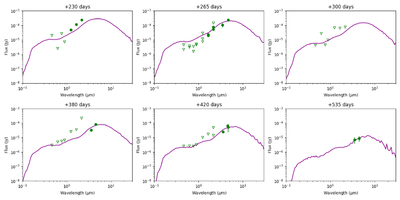
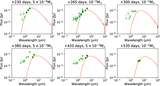
Caption: Figure 6.
Continuation of Figure 5, showing only the best-fitting model from that grid. Predicted SED evolution for a smooth CSM shell (0.005–0.25 pc) composed of amorphous carbon grains with a = 0.1 μm. The symbols are the same as in Figure 3. This model yields the best overall agreement with the observed NIR/MIR fluxes among the CSM-shell geometries investigated, but it is disfavoured because it implies an optical depth that would violate the early-time optical 3σ limits and an inner radius that would lead to ejecta interaction after ∼1 yr (Section 4.2).
Other Images in This Article
Show More
Copyright and Terms & Conditions
© 2026. The Author(s). Published by the American Astronomical Society.

Copyright ©
2026 Astronomy Image Explorer. All Rights Reserved.
