

Image Details
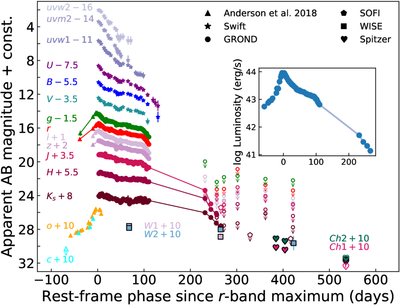
Caption: Figure 1.
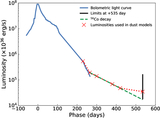
Multiband, host-subtracted light curves of SN 2018bsz. Photometric measurements have not been corrected for Milky Way or host galaxy extinction. The prepeak light curves are taken from J. P. Anderson et al. (2018). Marker shapes indicate data points taken using different facilities. The open symbols show 3σ detection limits. The inset panel shows the bolometric light curve of SN 2018bsz (uncertainties are smaller than the point size). Note that at late-time phases (>200 days), the SN was not detected in the optical but still detected in the NIR bands, with r − Ks > 5 mag.
Other Images in This Article
Show More
Copyright and Terms & Conditions
© 2026. The Author(s). Published by the American Astronomical Society.

Copyright ©
2026 Astronomy Image Explorer. All Rights Reserved.
