Image Details

Choose export citation format:

SN 2018bsz: Significant Dust Formation in a Nearby Superluminous Supernova

  • Authors: T.-W. Chen, 婷琬 陳, S. J. Brennan, R. Wesson, M. Fraser, T. Schweyer, C. Inserra, S. Schulze, M. Nicholl, J. P. Anderson, E. Y. Hsiao, 亦麒 蕭, A. Jerkstrand, E. Kankare, E. C. Kool, T. Kravtsov, H. Kuncarayakti, G. Leloudas, C.-J. Li, 傳睿 李, M. Matsuura, M. Pursiainen, R. Roy, A. J. Ruiter, P. Schady, I. R. Seitenzahl, J. Sollerman, L. Tartaglia, L. Wang, R. M. Yates, S. Yang, 圣 杨, D. Baade, R. Carini, A. Gal-Yam, L. Galbany, S. González-Gaitán, M. Gromadzki, C. P. Gutiérrez, R. Kotak, K. Maguire, P. A. Mazzali, T. E. Müller-Bravo, E. Paraskeva, P. J. Pessi, G. Pignata, A. Rau, D. R. Young

T.-W. Chen et al 2026 The Astrophysical Journal 1009 .

  • Provider: AAS Journals

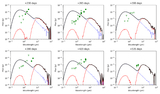
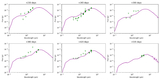
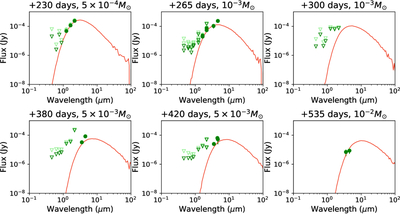
Caption: Figure 8.

Predicted emission from new dust in the SN ejecta at epochs from +230 to +535 days after the peak. The symbols are the same as those used in Figure 3. Here, we also include the SN magnitudes assuming a high host galaxy extinction of AV  =  1 mag, shown in light green. The assumed dust model is described in Section 4.4.

Other Images in This Article
Show More

Copyright and Terms & Conditions

Additional terms of reuse