

Image Details
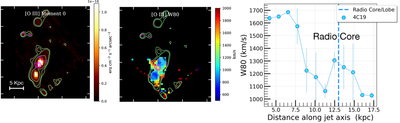
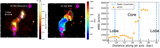
Caption: Figure 11.
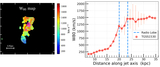
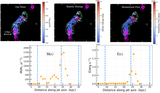
Spatially resolved maps of [O III]5007 moment 0 flux map (left panel), W80 line width map (middle panel), and radial profile of W80 as a function of distance along the putative jet axis (right panel) in 4C+19.71. The symbols, contours, and annotations follow the same conventions as Figure 8. The magenta contour marks the position of the radio core, and the two radio lobes are outside the IFU field of view. From the 2D W80 map, it is clear that the broadest lines with W80 > 1500 km s−1 are concentrated near the radio core. When we compute average line widths in 1 kpc wide rectangular boxes and compute the radial profile, we find that W80 generally declines with increasing distance. It should be noted that the measurements at small radial distances are affected by limited spaxel sampling, and line widths could not be reliably measured at the northern radio lobe location either due to a low S/N. A clear enhancement in W80 is still observed near the radio core, consistent with localized kinematic disturbance. Although the hypothesis that the strongest kinematic disturbance is concentrated near the AGN still holds for this source, the radial profiles are less indicative of the scenario.
Other Images in This Article
Show More
Copyright and Terms & Conditions
© 2026. The Author(s). Published by the American Astronomical Society.

