

Image Details
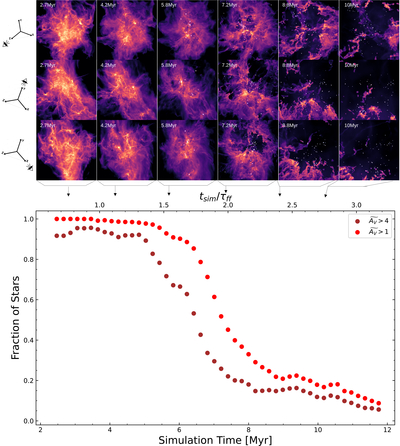
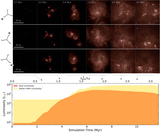
Caption: Figure 4.
Top panels: snapshots from six simulation times, with each box covering 30 pc. Different rows correspond to three different viewing angles. Gas surface density is shown in the color map, and stars rendered with a standard HST point-spread function (PSF). Stellar magnitudes are determined by considering the line-of-sight gas column density. Bottom panel: scatter plot showing the fraction of stars with a ﹩\widetilde{{A}_{{\rm{V}}}}﹩ > 4 (brown), and >1 (red) as a function of simulation time, where the median is defined by 60 different viewing angles. The stars in the formation event emerge from their natal cloud relatively quickly, with a steep decline in the fraction of stars that are highly extincted occurring over a ∼1 Myr period at 6 Myr. It is also important to note that this model does not produce a gravitationally bound stellar cluster. Rather, the association disperses entirely by 10 Myr, which can be seen in the rightmost panel of simulation snapshots.
Other Images in This Article
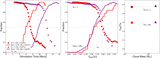
Show More
Copyright and Terms & Conditions
© 2026. The Author(s). Published by the American Astronomical Society.

