

Image Details
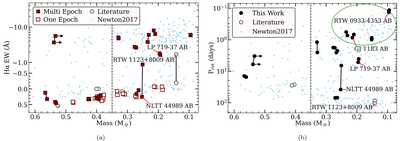
Caption: Figure 17.
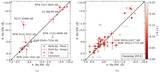
The estimated masses of binary components in our Results Sample are plotted against their (a) Hα EWs and (b) rotation periods. Values are from Table 2, Table 3, Table 6, and C25, and we only plot systems with measurements available for both components. Twin pairs are connected by black lines, and field star results from N17 are underplotted in light blue. The y-axes are set such that a star with more emission or faster rotation moves upward on the plots. A vertical dashed line at 0.35 M⊙ in each plot approximately divides PC and FC stars. Arrows indicate the less-reliable mass upper limits for the PMS case of 2MA 0201+0117 AB. Various systems discussed in the text are labeled. Panel (a): the y-axis is scaled linearly between −0.5 Å and +0.5 Å and logarithmically outside these bounds. Squares represent CHIRON EWs, only including nonflaring epochs with both stars successfully observed back to back, and observed EW ranges in multiepoch cases are not shown for visual clarity. The lack of active/inactive mismatched cases in the PC regime above 0.35 M⊙ may simply be due to these stars having largely already evolved to inactivity. Panel (b): for RTW 0409+4623 AB, we assign A the 2.55 day period and B the 2.24 day period for plotting purposes. A green ellipse roughly indicates the approximate region of parameter space in rapidly rotating low-mass stars where a bistable dynamo is hypothesized to possibly occur, which may be responsible for some of the behaviors we observe.
Other Images in This Article
Show More
Copyright and Terms & Conditions
© 2026. The Author(s). Published by the American Astronomical Society.

