

Image Details
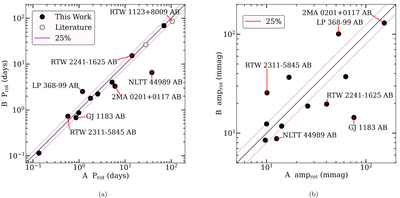
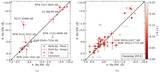
Caption: Figure 13.
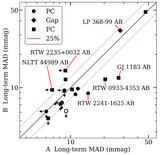
Comparisons of rotation periods and peak-to-peak rotation amplitudes (amprot) between the A and B components in our twin binary Results Sample are shown, using values from Table 6 and C25. One-to-one lines and corresponding 25% (1.25×) bounding lines are shown. For plotting purposes, we assign RTW 0409+4623 A the 2.55 day period and corresponding 7.1 mmag amplitude, RTW 0409+4623 B the 2.24 day period and corresponding 5.9 mmag amplitude, and then double the amplitudes for RTW 0409+4623 AB and RTW 2202+5537 AB, as discussed in Section 8. The measurements for different systems are derived from photometry in different filters, so care should be taken if comparing amplitudes in panel (b) across systems and not just between twin components. Several systems discussed in the text are labeled. Many systems show stunning alignment in their components’ resolved rotation periods, including cases spanning rapid to slow rotation and across a large range of the M dwarf sequence; however, key mismatched systems appear as well. The corresponding rotational photometric variability amplitudes show larger scatter, as expected given the potentially changing nature of photometric contrast effects.
Other Images in This Article
Show More
Copyright and Terms & Conditions
© 2026. The Author(s). Published by the American Astronomical Society.

