

Image Details
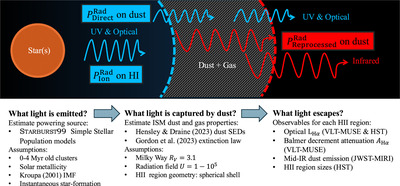
Caption: Figure 1.
Radiation pressure in H II regions. UV and optical photons emitted from the central powering source interact with the surrounding dusty ISM. This results in ﹩{P}_{{\rm{Direct}}}^{{\rm{Rad}}}﹩ due to absorption and scattering off of dust grains and ﹩{P}_{{\rm{Ion}}}^{{\rm{Rad}}}﹩ due to H ionization. IR-reprocessed photons emitted by dust grains also interact with the dusty ISM. This results in an additional ﹩{P}_{{\rm{Reprocessed}}}^{{\rm{Rad}}}﹩ due to absorption of these IR photons by dust. With the assumptions indicated, Hα emission is used to estimate ﹩{P}_{{\rm{Ion}}}^{{\rm{Rad}}}﹩. Hα and the Balmer decrement extinction are used to estimate ﹩{P}_{{\rm{Direct}}}^{{\rm{Rad}}}﹩. Mid-IR dust emission and estimated mid-IR extinction are used to calculate ﹩{P}_{{\rm{Reprocessed}}}^{{\rm{Rad}}}﹩. See details in Section 3.
Other Images in This Article

Show More
Copyright and Terms & Conditions
© 2025. The Author(s). Published by the American Astronomical Society.

