

Image Details
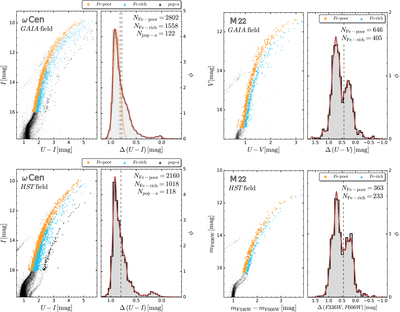
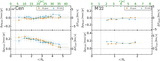
Caption: Figure 1.
I vs. U − I and V vs. U − V diagrams for the selected cluster members of ω Centauri (upper left) and M22 (upper right) from ground-based photometry (upper panels). We also show the histogram and the kernel-density distributions of ﹩{\rm{\Delta }}(U-I)﹩ and ﹩{\rm{\Delta }}(U-V)﹩ for the selected RGB stars of ω Centauri and M22. The vertical dashed black lines are used to select Fe-poor and Fe-rich stars in procedure I, marked with orange circles and cyan triangles, respectively. The orange Gaussian and the dashed gray lines in the top left panels are adopted to identify alternative groups of stars with different metallicities of ω Centauri from procedures II and III. See text for details. The lower panels show the corresponding diagrams from HST photometry of stars in the internal fields. To ensure consistency between the selection of Fe-poor and Fe-rich stars in the two fields of ω Centauri, we converted HST magnitudes ﹩{m}_{{\rm{F}}336{\rm{W}}}﹩ and ﹩{m}_{{\rm{F}}814{\rm{W}}}﹩ into U and I magnitudes of the photometric system by Landolt (1992).
Other Images in This Article
Show More
Copyright and Terms & Conditions
© 2020. The American Astronomical Society. All rights reserved.

