

Image Details
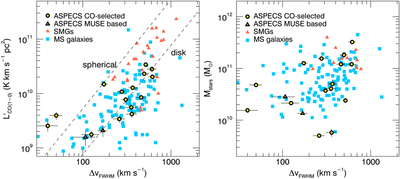
Caption: Figure 3.
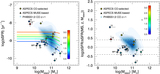
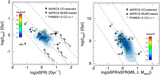
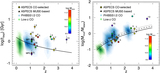
(Left) Estimated CO(1−0) line luminosities as a function of the line widths (Δ vFWHM) for the ASPECS sources, compared to a compilation of galaxies from the literature detected in CO line emission, including unlensed submillimeter galaxies (Frayer et al. 2008; Coppin et al. 2010; Carilli et al. 2011; Riechers et al. 2011, 2014; Thomson et al. 2012; Bothwell et al. 2013; Hodge et al. 2013; Ivison et al. 2013, 2011; De Breuck et al. 2014) and MS galaxies (Daddi et al. 2010b; Magnelli et al. 2012; Magdis et al. 2012, 2017; Tacconi et al. 2013; Freundlich et al. 2019). The dashed lines represent a simple “virial” functional form for the CO luminosity for a compact starburst and an extended disk (Section 3.2). The actual location of each of these lines depends on the choice of geometry and αCO factor. (Right) Stellar masses vs. line widths for the ASPECS sources, compared to the literature (where stellar mass estimates are available).
Other Images in This Article
Show More
Copyright and Terms & Conditions
© 2019. The American Astronomical Society. All rights reserved.

