

Image Details
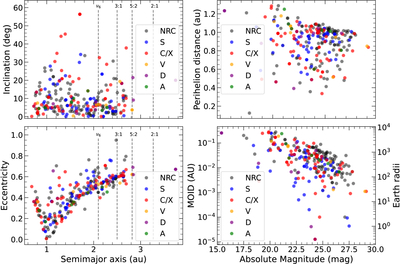
Caption: Figure 8.
Orbital element distribution for all classified NEOs in our sample. The left panels illustrate the inclination and eccentricity as a function of semimajor axis. The right panels shows the minimum orbit intersection distance (MOID) and perihelion distance as a function of absolute magnitude. The sample spans the canonical near-Earth orbital parameter space, with a concentration at low inclinations. Seven objects have relatively low MOIDs, which if we assume a conservative five Earth radius limit as the minimum distance an object has to fly by the Earth to experience tidal forces, then they may have experienced regolith resurfacing (R. P. Binzel et al. 2019). The objects in black refer to those with nonreliable classification (NRC).
Other Images in This Article
Copyright and Terms & Conditions
© 2026. The Author(s). Published by the American Astronomical Society.

